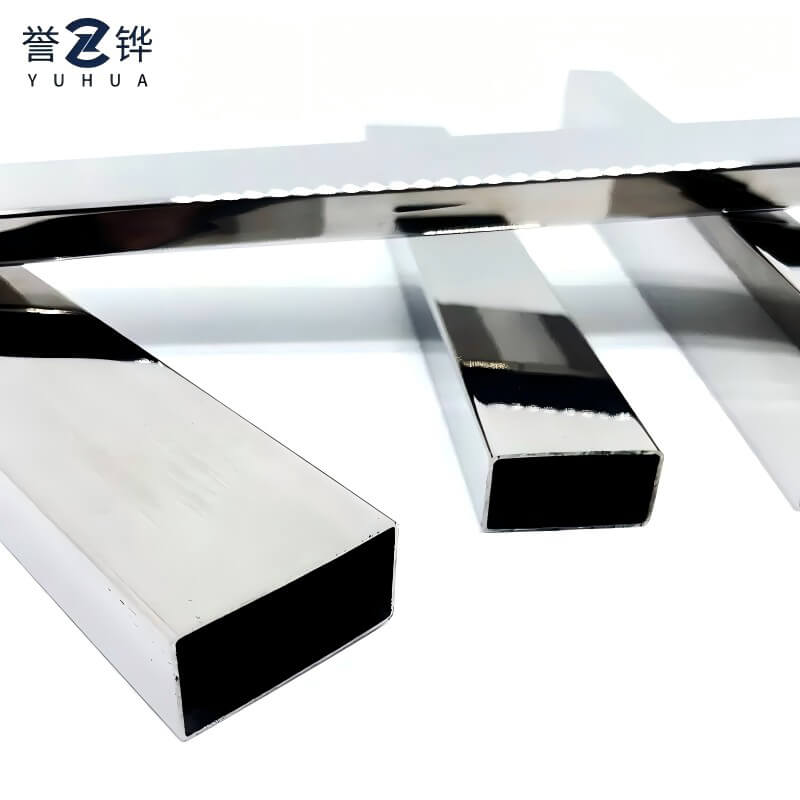


Understanding tube weight before placing an order is very helpful. It allows buyers to figure out material usage and shipping costs. It also helps with planning handling requirements and total project mass. For stainless steel square and rectangular tube products, the weight relies mostly on a few factors. These include outside dimensions, wall thickness, overall length, and the metal’s density.
This guide explains how to estimate mass in kg/m and lb/ft. Buyers can then use the result when preparing an RFQ.
The figures below are theoretical calculation references. They are not a stock list. Confirm actual shipment mass against the final specification.

The charts below use 7.93 g/cm³ as a single reference density for theoretical weight estimation. Actual theoretical weight may vary slightly depending on the stainless steel grade and the density value used.
| Outside Size | Wall Thickness | Theoretical Weight |
| 20 × 20 mm | 1.0 mm | 0.603 kg/m |
| 20 × 20 mm | 1.2 mm | 0.716 kg/m |
| 20 × 20 mm | 1.5 mm | 0.880 kg/m |
| 25 × 25 mm | 1.0 mm | 0.761 kg/m |
| 30 × 30 mm | 1.5 mm | 1.356 kg/m |
| 40 × 40 mm | 2.0 mm | 2.411 kg/m |
| 50 × 50 mm | 2.0 mm | 3.045 kg/m |
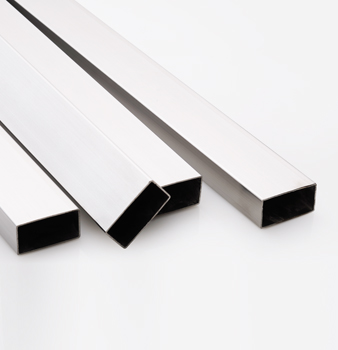
YUHUA 1.5 m, 20 × 20 mm Grade 304 square tube provides a useful product reference. Its outer-dimension tolerance is ±0.13 mm. Straightness is ≤1.5 mm/m. Corner radius is ≤2.0 mm. These details help explain why a theoretical chart is for planning rather than certified shipping mass.
| Outside Size | Wall Thickness | Theoretical Weight |
| 20 × 10 mm | 0.8 mm | 0.360 kg/m |
| 30 × 20 mm | 1.0 mm | 0.761 kg/m |
| 40 × 20 mm | 1.5 mm | 1.356 kg/m |
| 50 × 25 mm | 1.5 mm | 1.713 kg/m |
| 60 × 40 mm | 2.0 mm | 3.045 kg/m |
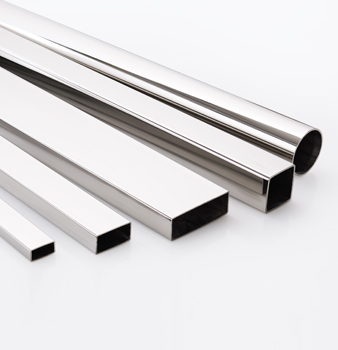
YUHUA also has a 20 × 10 mm rectangular tube reference with 0.8 mm wall thickness and 1500 mm length. This reference comes with 304/310 material options. It also offers bright, pickled, polished, or annealed surface options. For purchasing, match the calculation to the exact width, height, thickness, grade, and length on the inquiry.
For U.S. projects, convert kg/m to lb/ft using:
lb/ft = kg/m × 0.67197
| Tube Size | kg/m | lb/ft |
| 20 × 20 × 1.0 mm square | 0.603 | 0.405 |
| 20 × 20 × 1.5 mm square | 0.880 | 0.591 |
| 20 × 10 × 0.8 mm rectangular | 0.360 | 0.242 |
| 50 × 25 × 1.5 mm rectangular | 1.713 | 1.151 |
This conversion is useful when drawings use metric dimensions but freight estimates or bills of materials are prepared in imperial units.
A calculator is convenient. The formula helps buyers check quotations and compare wall thicknesses.
Let B be the outside width in mm and t the wall thickness in mm.
Cross-sectional area (mm²) = B² − (B − 2t)²
Weight (kg/m) = Area × Density (g/cm³) × 0.001
Using 7.93 g/cm³ as the estimating density:
Weight (kg/m) = [B² − (B − 2t)²] × 0.00793
The formula assumes a uniform wall and idealized square corners. The formula is suitable for preliminary engineering, purchasing comparisons, and freight estimates.
Let B be outside width, H outside height, and t wall thickness.
Cross-sectional area (mm²) = B × H − (B − 2t) × (H − 2t)
Weight (kg/m) = Area × Density × 0.001
For a 7.93 g/cm³ estimating density:
Weight (kg/m) = [B × H − (B − 2t)(H − 2t)] × 0.00793
The same method allows quick comparison of rectangular sections with identical outside dimensions but different thicknesses.
Case study: consider a 20 × 20 × 1.2 mm square tube with a length of 1.5 m.
1.Metal area = 20² − 17.6² = 90.24 mm².
2.Weight per meter = 90.24 × 0.00793 = about 0.716 kg/m.
3.Weight per piece = 0.716 × 1.5 = about 1.073 kg.
4.For 100 pieces, theoretical total weight is about 107.3 kg.
This calculation supports order planning, bundle estimates, and transport costing before final production weight is available.
Wall thickness has a strong effect because it changes the amount of metal around the section. Increasing a 20 × 20 mm square tube from 1.0 mm to 1.5 mm raises theoretical weight from about 0.603 to 0.880 kg/m.
Outside dimensions also affect material consumption and section behavior. Selecting a tube only by nominal width or height can produce inaccurate purchasing estimates.
Different grades have slightly different densities. For identical dimensions, the density effect is usually smaller than a change in wall thickness. Still, use the selected grade density when accurate tonnage estimates are required.
Calculated weight is an estimate. Real tubes have dimensional tolerances, wall-thickness tolerances, welded seams, and corner radii. One ASTM A554 welded-tube reference lists a wall-thickness tolerance of ±10%. The applicable tolerance should be confirmed according to the exact product specification and order requirements.
For freight booking, final costing, or weight-sensitive fabrication, use the confirmed production specification or actual shipment weight.

Once kg/m is known, procurement teams can calculate:
1.Piece weight = kg/m × piece length.
2.Order weight = piece weight × quantity.
3.Approximate freight weight = order weight plus packaging and shipping materials.
4.Material comparison = compare total weight after changing thickness, size, or grade.
This helps avoid underestimating tonnage on projects involving many lengths.
A well-written RFQ needs to contain several important details. You should list the desired profile shape, specific stainless steel grade, and exact outside measurements. Also, include the wall thickness, cut length, total piece quantity, and required surface finish. Finally, mention any relevant industrial standards, testing needs, and tight manufacturing tolerances.
Complete specifications allow us to evaluate the requirement accurately rather than relying on weight alone.
Weight is only one selection factor. The final choice should also reflect corrosion environment, fabrication method, appearance, dimensions, and project standard.
When you send us an initial inquiry, please list the profile size and wall thickness right away. After that, our sales team can review the specific grade, surface finish, and cut lengths. We will also discuss order quantities and strict inspection rules with you directly.
A: There is no single value because weight depends on outside size and wall thickness. For example, a 20 × 20 × 1.2 mm section is approximately 0.716 kg/m when calculated using the 7.93 g/cm³ reference density adopted for the theoretical weight chart in this guide.
A: For identical dimensions, weight can be slightly different because grade density varies. But the effect is generally small compared with changing wall thickness or outside dimensions.
A: Theoretical formulas assume ideal dimensions and uniform walls. Actual weight may vary because of dimensional tolerance, wall-thickness tolerance, corner radius, weld geometry, and production variation. Use calculated weight for planning and confirm final shipment weight for commercial or logistics purposes.
 Address: Muyuan Industrial Zone, Shishan Town, Nanhai District, Foshan City, Guangdong Province
 Call us now:+86 13751499396
 Email:546980277@qq.com


Foshan Nanhai Yuhua Hardware Products Co., Ltd.佛山市南海誉华五金制品有限公司