

A useful stainless steel tube RFQ defines the application, standard, grade, profile, manufacturing route, dimensions, tolerances, finish, testing, quantity, documentation, packing and destination. Missing fields may cause suppliers to price different products under one description. This checklist turns a general request into a specification that can be quoted and inspected consistently.

The lowest quotation is not automatically the lowest project cost. One offer may include polishing, inspection and export packing, while another covers unfinished tubing only. A complete RFQ exposes these differences before purchase.
| RFQ field | What it controls | Risk if omitted |
| Grade and standard | Material and production requirements | Unapproved substitution |
| Size and tolerance | Fit, fabrication and weight | Assembly or cost differences |
| Finish | Appearance and further processing | Rework or surface rejection |
| Tests and certificates | Acceptance evidence | Delayed approval |
| Quantity and delivery scope | Production and logistics | Incomparable landed prices |
Tell the supplier whether the tube will become a handrail, furniture frame, machine guard, exhaust component or process line. The application identifies critical characteristics. Also distinguish tube from pipe sizing. Tube is commonly ordered by actual outside diameter and wall thickness, whereas pipe often uses NPS and Schedule. “Two-inch stainless steel” could mean 2-inch OD tubing or NPS 2 pipe with a different actual diameter.
Connect material grade to the standard, shape and production method.
Choose by exposure and downstream processing, not a good-better-best ranking.
*Grade 201 can suit cost-conscious decorative or structural work in moderate environments.
*Grade 304 or 304L serves many general fabrication, equipment and architectural applications.
*Grade 316L contains molybdenum and is often considered for chloride, marine, chemical and pharmaceutical environments.
*Grades 410 and 430 may meet particular magnetic, decorative, furniture or wear-related needs.
State the medium, temperature, cleaning method, exposure, welding and forming requirements.
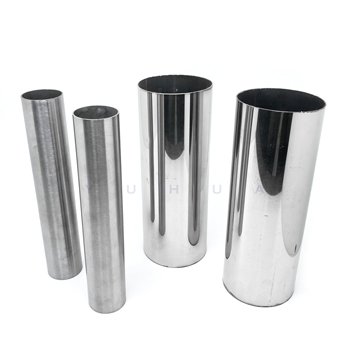
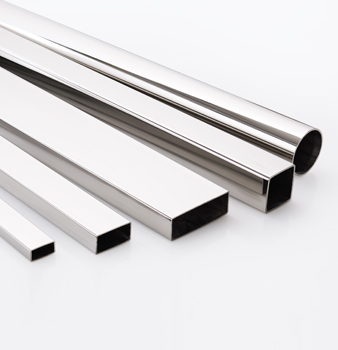
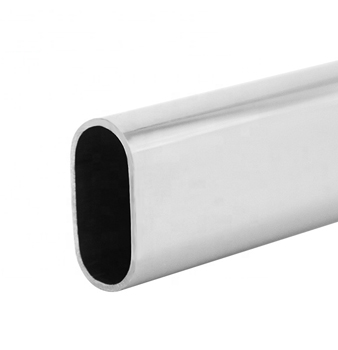
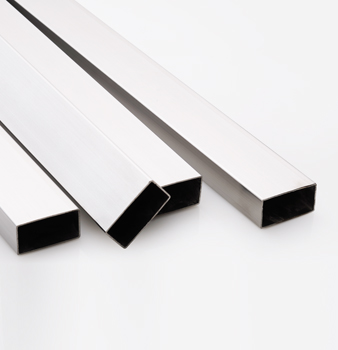
Specify round, square, rectangular or another profile, including corner requirements for shaped sections. Welded tubing often suits furniture, handrails, equipment frames, exhaust parts and decorative fabrication. Seamless tubing may be required by a service standard or particular pressure and temperature conditions, but it does not automatically provide tighter tolerances.
At YUHUA, our ASTM A554 welded range includes 201, 304, 304L, 316 and 316L in round, square and rectangular profiles, with tube sizes from 3/8 to 4 inches across available configurations.
Write dimensions as measurable acceptance criteria.
For round tube, use OD × wall thickness × length. For shaped tube, use outside width × height × wall thickness × length. Then confirm:
1.Millimetres or inches for every value.
2.Fixed, random or custom-cut length.
3.Piece count or total weight and permitted variation.
4.End condition, such as square cut or deburred.
If ID controls flow or accepts an insert, specify it rather than deriving it from nominal OD and wall.
Control what affects function: outside dimension, wall thickness, straightness, ovality, cut length, end squareness or corner radius. Unnecessarily tight limits add cost without improving the assembly.
Terms such as “polished” or “good surface” are subjective. Name the required condition, such as annealed, pickled, brushed, matte or mirror. Add a roughness value or approved sample when appearance or cleanability is critical. At YUHUA, we can provide mirror, brushed and matte finishes for relevant ASTM A554 configurations. Identify cosmetic faces, permitted weld visibility and later fabrication. Also define film, separators, end protection and moisture-resistant packing where required.
Testing should prove the agreed acceptance criteria.
Begin with tests required by the governing specification, then add project controls. An inspection plan may cover material verification, dimensions, surface condition and the weld seam. At YUHUA, ASTM A554 welded tubes can receive eddy-current testing for weld integrity; hydrostatic testing is available when required by the agreed scope. State sampling rate, acceptance limits, report format and measurement method. A test name without acceptance criteria can still cause disagreement.
Request the records needed for approval: mill test certificate, heat or batch identification, dimensional report and applicable test results. At YUHUA, we support material traceability and MTC supply for relevant orders. State quantity, permitted variation, packing, shipping marks, destination, Incoterm, required date and whether partial shipment is acceptable. Agree on waterproof wrapping, steel straps or other seaworthy protection according to profile, finish and transport method.
Use this order: application; standard and edition; grade; profile; manufacturing route; dimensions; tolerances; ends; finish; tests; certificates; quantity; packing; destination; delivery term and date.
Example: “Furniture-frame tube; ASTM A554; grade 304; welded square profile; 20 × 20 × 1.2 mm; 1,500 mm fixed length; outside dimension ±0.13 mm; straightness ≤1.5 mm/m; annealed finish; deburred square-cut ends; eddy-current tested; MTC required; [quantity]; protected export packing; [destination and Incoterm]; [required date].”
Replace the bracketed fields and confirm all limits against the project drawing.

Send us the application, drawing or dimensional schedule so we can review grade, profile, manufacturing route, finish and inspection scope together. We also check whether critical tolerances are measurable and packing suits the surface and shipment. Sharing annual volume, order quantity, destination and required date reduces clarification. Contact YUHUA with the complete specification so we can evaluate feasibility and quote the scope your purchasing and quality teams will approve.
A: Provide the application, standard, grade, profile, route, dimensions, tolerances, finish, quantity, tests, certificates, packing, destination and date. Attach a drawing when fit or appearance is critical.
A: State actual dimensions with units, then assign separate tolerances to functional features such as OD, ID, wall, straightness, ovality, cut length, end squareness or corner radius.
A: Select it according to corrosion exposure, temperature, cleaning, fabrication, appearance and the applicable standard. No grade is best for every environment.
A: Start with the governing standard, then add required material, dimensional, surface, mechanical, weld or pressure tests. Include sampling, acceptance criteria and reports.
A: Choose according to the standard, service, fabrication, dimensions, finish, inspection and availability. Seamless is required for some services; welded tube suits many mechanical, structural and decorative applications.
 Address: Muyuan Industrial Zone, Shishan Town, Nanhai District, Foshan City, Guangdong Province
 Call us now:+86 13751499396
 Email:546980277@qq.com


Foshan Nanhai Yuhua Hardware Products Co., Ltd.佛山市南海誉华五金制品有限公司